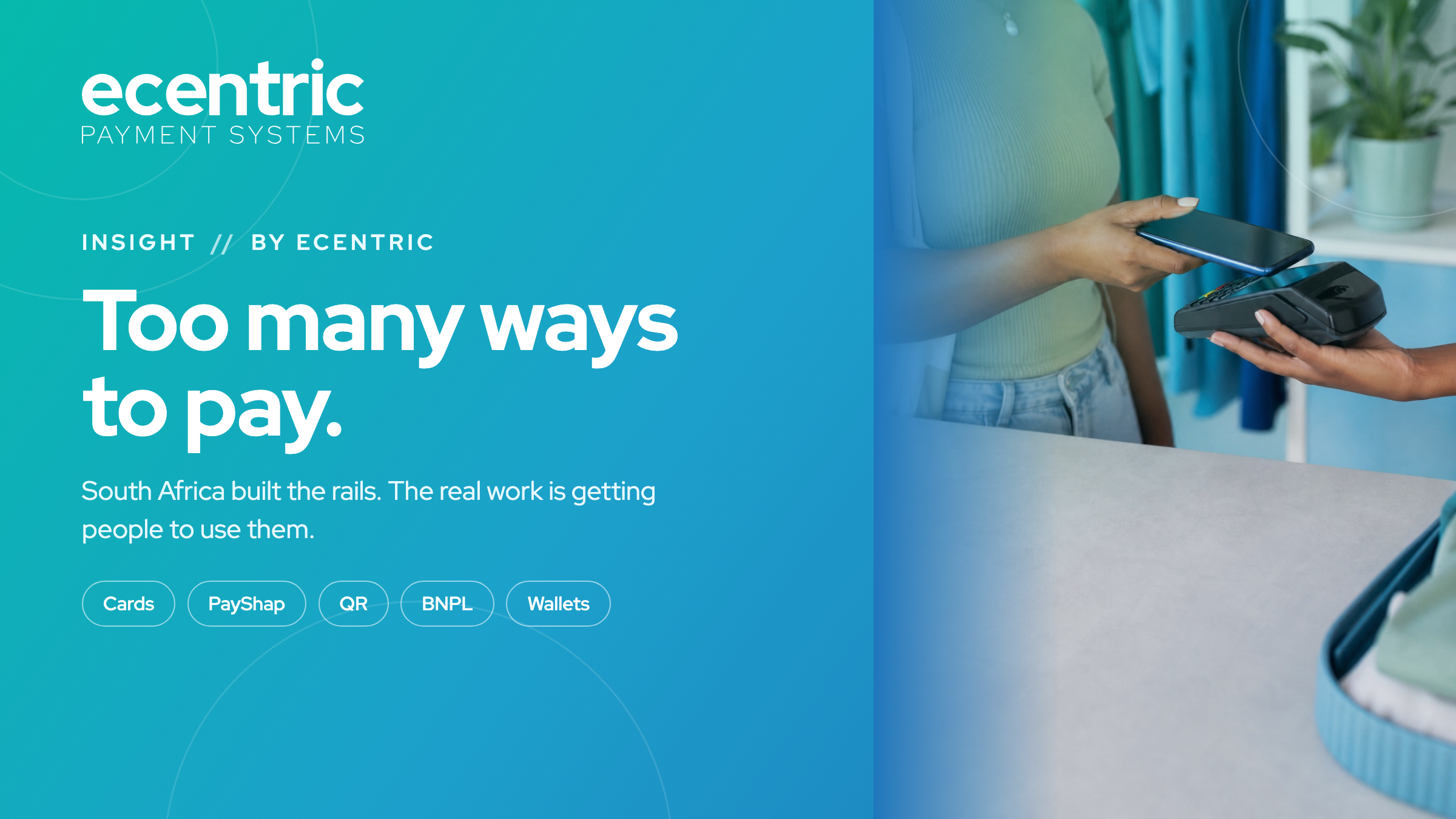
Standing at a till in South Africa in 2026, you have more ways to pay than ever before. Cards, PayShap, QR codes, BNPL, digital wallets, loyalty points, cash. The infrastructure is there. What the market is still working through is something harder to engineer: getting people to use it.
The options are real, and they’re growing. South Africa’s payment infrastructure has evolved faster than almost anyone anticipated, driven in large part by the South African Reserve Bank’s Payments Ecosystem Modernization (PEM) programme and its Vision 2025 agenda. The regulatory foundations are in place. The rails are built. What the market is still working through is something harder to engineer: adoption.
The PayShap Paradox
PayShap is probably the clearest illustration of the gap between what exists and what people use.
Launched in March 2023, it was designed from the ground up to rival cash instant, interoperable, low-cost, and built into the banking apps most South Africans already have on their phones. By the end of 2025, it had processed more than 461 million transactions. Those are not small numbers.
And yet, Capitec, the market leader in PayShap transactions, holds only a 59% share of all PayShap payments nationally, which itself represents just a fraction of the bank’s overall debit activity. Three years after launch, PayShap hasn’t become the default for instant payments. Most users still reach for their card or their digital wallet, paying fees they know and understand, because the known quantity feels safer than the better product.
This is not a technology problem. PayShap works. What it hasn’t fully cracked is awareness, trust, and perceived cost, the three things that sit between a well-built solution and a widely used one. Brand recognition exists, but recognition is not the same as education, and in a market where the barriers to adoption can be cost, access to technology, or simply ingrained behavior, that distinction matters enormously.
What Merchants Are Actually Dealing With
For merchants, the accumulation of payment methods isn’t a triumph; it’s an operational reality they must manage whether they like it or not.
A retailer today isn’t choosing a payment method. They’re building a stack of them because their customers are spread across every available option, and meeting the customer where they are means accepting everything. Each method card, QR, PayShap, BNPL sits at a different point in the operational ecosystem. Each has its own onboarding, its own reconciliation process, its own failure modes.
The cashier trained in buy-now-pay-later six months ago still must navigate that process fluently in real time, while the customer is toggling between apps and the queue is building. Speed and simplicity at the point of sale are not optional features; they’re what keep a transaction from becoming an experience people remember for the wrong reasons.
Why BNPL Succeeded Where QR Codes Didn’t
It’s worth asking why some alternative payment methods take hold while others stall. Buy-now-pay-later is a useful case study.
BNPL gained meaningful traction in South Africa at a time when QR code payments were barely moving. The reason wasn’t superior technology or better marketing. It was that BNPL solved a problem millions of South Africans felt directly and immediately: managing constrained cash flow. A consumer with R400 in hand and a R2,000 need could make the purchase and spread the balance over time, while the merchant received full payment upfront. The mechanism earned adoption because it addressed something real, not because it was novel.
That lesson applies to every alternative payment method trying to find its footing. If the value proposition doesn’t map onto a genuine, felt need and if users don’t understand it clearly enough to trust it, adoption will lag regardless of how well the product works.
The On-Ramp Problem
The practical implication here is twofold.
First, the ecosystem needs interoperability. A fragmented environment where every alternative payment method lives in its own closed loop with its own app, its own onboarding, and its own account places the burden of navigation on the consumer and the merchant. Interconnected functionality reduces that friction.
Second, education needs to follow people to where they transact, not where the industry assumes they are. Understanding drives use. If a consumer genuinely grasps what PayShap does, why it’s secure, and what it costs compared to the alternatives they already know, they are far more likely to reach for it.
Why Cards Aren’t Going Anywhere
All of this is why cards are unlikely to disappear from South Africa’s payment landscape any time soon. They are widely understood, accepted across virtually every merchant environment, and trusted in a way that takes years, not months, to build. That trust is an asset that took decades to earn, and it won’t be displaced by a better product alone.
If the industry is serious about shifting behaviour, not just expanding the menu of options, it needs to treat adoption as a discipline, not a by-product of infrastructure. That means investing in the on ramps: the education, the interoperability, the merchant support, and the consumer experience that get people from knowing a payment method exists to using it.
Building the rails is the beginning. Getting people on the train is the work that still needs to be done.
Ntombenhle “Enhle” Mposula – IPP Product Manager at Ecentric Payment Systems