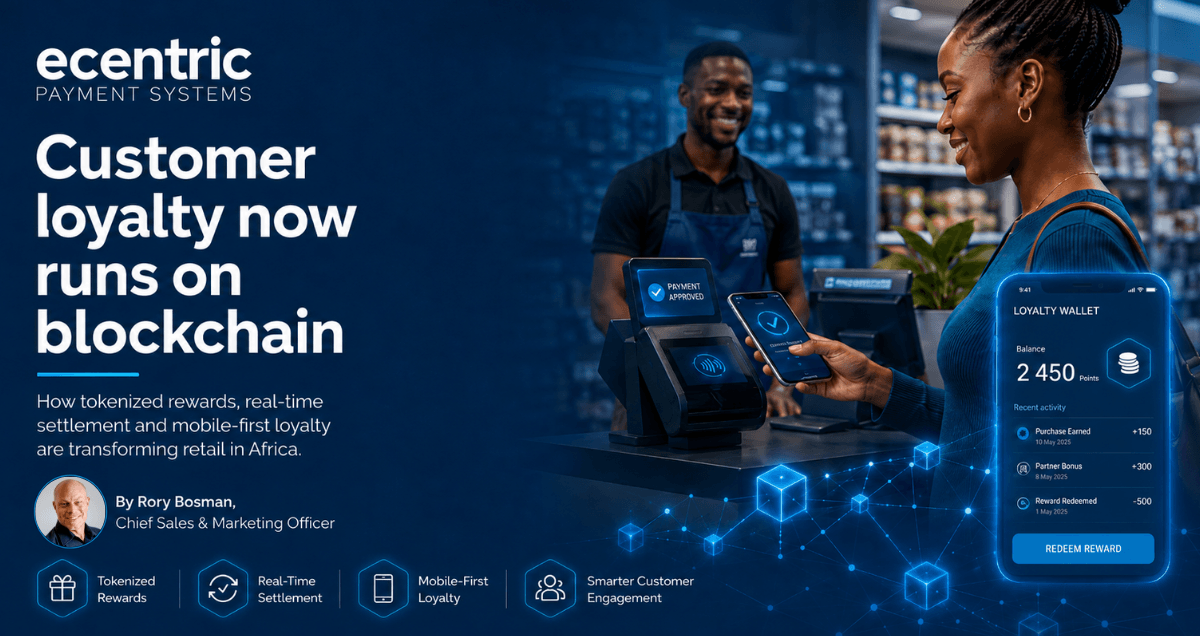
The programmes that reward shoppers with points and plastic cards were built for a different era of retail. They served their purpose, but the landscape has shifted, and in markets like South Africa and across the African continent, the gap between what customers expect and what traditional loyalty infrastructure can deliver is widening.
Africa’s loyalty market is forecast to grow at 18.1%, driven by demand for mobile-first rewards, gamification, cashback mechanisms, and genuine financial inclusion. That growth signals appetite. What it also signals is that the window for retailers to modernize their loyalty offering is open, but not indefinitely.
The structural limits of traditional loyalty
Loyalty remains one of the most powerful levers in retail. The challenge is not the concept, it’s the architecture.
Traditional programmes place significant operational weight on retailers. Unredeemed points accumulate as contingent liabilities on balance sheets, creating long-term financial exposure that’s difficult to manage and harder to justify. Meanwhile, customers are navigating fragmented systems, physical cards, and programmes that lean heavily on basic discounts while barely scratching the surface of the data they generate.
The outcome is predictable: low differentiation, low engagement, and a quiet erosion of the loyalty relationship even when membership numbers appear strong. Retailers can see the potential value of a well-run loyalty programme. The infrastructure, too often, works against them.
What blockchain changes
Web3 and blockchain have matured well beyond their early associations with cryptocurrency speculation. Their application to retail loyalty is practical, scalable, and increasingly compelling. The fundamental shift is tokenization. Instead of points sitting dormant in a legacy system generating liability while waiting to be redeemed, value becomes a live, transferable digital asset. Rewards can be earned, settled, and redeemed at the exact moment of purchase, without batching, without reconciliation delays, and without the friction that erodes the customer experience in traditional models.
The trust layer that enables this is built into the technology itself. Two customers at neighboring tills can receive entirely different, personalized offers in real time, informed by who they are and how they shop, while blockchain handles settlement seamlessly in the background. That level of precision and immediacy simply isn’t achievable in conventional systems.
Removing the financial drag
The real-time settlement model does more than improve the customer experience. It resolves one of the more persistent financial headaches in retail loyalty.
Contingent liabilities tied to unredeemed points are not a minor inconvenience; they represent genuine long-term risk and complexity on the balance sheet. Web3 removes this structural burden by enabling digital rewards that function more like currency: issued, redeemed, and settled in the moment, with no deferred exposure left behind.
There is also a meaningful cost dimension. Card transactions carry merchant fees that quietly erode margin. Web3 wallet payments operate outside traditional cost architectures, which means the savings can be reinvested directly into the rewards programme itself. Loyalty, in this model, stops being a cost centre. It becomes a funded growth engine.
The data advantage
Loyalty programmes have always generated valuable data. The gap has been in how effectively that data gets used.
In a blockchain-enabled environment, all that insight into purchase behavior, frequency, preferences, and life stage indicators sits in a structured digital repository, ready to be interpreted and acted on. Retailers gain the ability to build consumer journeys that are genuinely responsive to how customers live, not just how they last transacted. The advertising and rewards experience moves with the customer’s life rather than defaulting to outdated assumptions.
This is the difference between a loyalty programme that collects data and one that uses it.
Accessibility at every level of the market
One of the more significant implications of blockchain-based loyalty is how broadly it applies across the retail ecosystem.
The same infrastructure that serves large enterprise retailers can equally support spaza shops, taxi associations, and informal traders. The rails are shared. The barriers to entry are removed. This is financial inclusion in a practical, commerce-driven form, and it represents a genuine expansion of what loyalty programmes can mean in the African context.
The next era of loyalty is not defined by more points or better app design. It is defined by infrastructure, real-time, interoperable, data-intelligent systems that meet customers where they are and settle value the moment it is earned.
Blockchain and Web3 are enabling that shift now. For retailers who understand what is at stake and move accordingly, the opportunity is substantial. For those who wait, the gap between their offering and customer expectation will only grow.
At Ecentric, building the infrastructure that makes this possible for merchants of every scale, across the continent, is central to what we do.