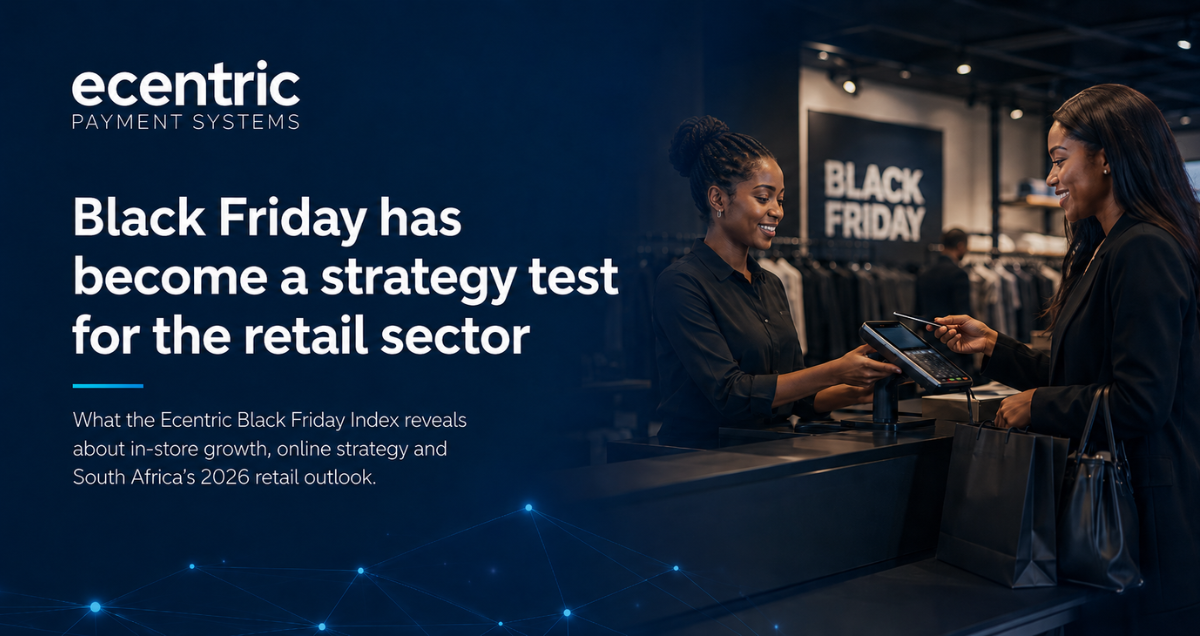
What began as a promotional import from the United States has evolved into one of the most commercially consequential moments in South African retail. The four-day Black Friday to Cyber Monday window BF-CM now generates between 20 and 30% of total holiday spending, consistently outperforming the broader November to December period in both transaction volume and revenue. With sales up 3.5% year on year as of November 2025, this narrow window has become one of the most concentrated and strategically decisive events in the retail calendar.
The implications for 2026 are significant. Online retail needs to rethink its approach. In-store retail needs to focus not solely on discounts, but on the shift from price-led promotions to experience-led engagement. And both channels need to understand what the data is saying.
What the numbers reveal
During a festive season that lasts nearly eight weeks, BF-CM consistently captures roughly a tenth of total transactions and revenue. That concentration of demand in just four days makes it one of the highest-stakes operational moments a retailer will face all year.
The Ecentric Black Friday Index, which measures BF-CM activity as a proportion of total holiday retail processed through the Ecentric payment gateway, tracked a telling divergence between channels in 2025.
Online share softened slightly year-on-year. BF-CM accounted for 9.08% of online holiday transaction volume and 10.6% of online holiday revenue in 2025, compared with 9.61% and 11.29%, respectively, in 2024. The window remained disproportionately powerful, but the momentum eased.
Physical retail moved in the opposite direction. In-store transaction share rose from 10.64% to 10.75%, and in-store revenue share climbed from 11.3% to 11.52% over the same period. Notably, revenue share grew faster than transaction share, a signal that points to larger baskets, stronger product mix, or more effective conversion of high-value purchases in-store.
These are not marginal shifts. They reflect a meaningful strategic divergence in how each channel is performing, and why.
The implications for 2026 are significant. Online retail needs to rethink its approach. In-store retail needs to focus not solely on discounts, but on the shift from price-led promotions to experience-led engagement. And both channels need to understand what the data is saying.
Why in-store is gaining ground
Physical retail is not outperforming digital because South African consumers have turned away from e-commerce. It is outperforming in the categories and contexts where retailers give shoppers a compelling reason to be there.
Appliances, electronics, and fashion remain categories where consumers want to see, touch, or try a product before committing. But the in-store gains seen in 2025 point to something more deliberate than category preference; they reflect retailers investing in the store as a destination. Events, exclusives, demonstrations, and considered merchandising are turning physical spaces into experiences rather than transaction points.
This is a critical strategic insight heading into 2026. The question is no longer how deep the discount should be. It is what kind of engagement drives profitable conversion. Retailers who rely on price cuts alone are, over time, training customers to wait for the markdown. Store-led urgency, exclusivity, and experiential theatre create a different dynamic that encourages customers to buy now, in person, and often at a higher basket value.
What online needs to do differently
Digital retail faces a different challenge. Blanket percentage discounts are a blunt instrument, and the data suggests they are becoming less effective at holding online share during BF-CM.
The path forward for online is precision. Tiered offers, product bundles, add-ons, and buy-more save more structures rebuild average order value in ways that broad discounting does not. Sharper segmentation with promotions tailored to new customers, returning customers, high-value segments, and lapsed shoppers offers more targeted upside than channel-wide price reductions that erode margin with limited gain.
The strongest retail operators are increasingly focused on directing the right offer to the right customer at the right moment, with as little friction as possible. BF-CM is where that discipline is tested most visibly.
The omnichannel reality
One of the clearest patterns in the data is how fluidly South African consumers move between channels. Digital is used for research and price comparison. Physical locations close the sale, particularly for high-consideration purchases, or where in-store exclusives make the visit worthwhile.
Retailers who lean too heavily on a single channel leave themselves exposed. The more durable strategy is synchronization: inventory, pricing, fulfilment, and promotions aligned across both environments. Stores can also serve as omnichannel hubs, handling click and collect, returns, and service interactions that create natural upsell opportunities and deepen the customer relationship.
The broader picture
Beyond the BF-CM window itself, the underlying market data remains encouraging. During the 2025 festive season, online transactions grew 13.4% and online revenue rose 5.7%. In-store transactions increased 6.0%, and in-store revenue grew 5.2%. The market is expanding. The competition for shares within it is intensifying.
BF-CM concentrates that competition into four days. It exposes operational weaknesses, punishes undifferentiated discounting and rewards retailers who understand the economics of genuine customer engagement. In 2026, the retailers who thrive will be those who use data to build better experiences, more considered offers, and stronger conversions across every touchpoint.
The Ecentric Black Friday Index measures the proportion of total holiday retail activity that takes place during the four-day Black Friday to Cyber Monday window, using transaction data processed through the Ecentric payment gateway across both online and in-store retail channels. The index compares this activity against the full holiday trading period from 1 November to 24 December.
Read the full Ecentric Black Friday Index report to inform your 2026 strategy. Access the report here.