Three questions are preoccupying South African retailers right now: how do you get customers through the door, how do you keep them there, and how do you persuade them to spend? Simple enough on paper, but against a backdrop of consumer financial stress and economic instability, none of them have easy answers.
The FNB/BER Consumer Confidence Index has crept up from -9 in the second quarter of 2025 to -7 in the first quarter of 2026, but it’s still firmly negative, and still deteriorating for lower-income South Africans.
DebtBusters’ 2025 Money-Stress Tracker puts it starkly: 70% of South Africans are experiencing money stress. Retailers are being squeezed from both sides, with price-sensitive shoppers focusing spend on essentials while operating costs keep climbing. In that environment, every missed sale hurts.
So, here’s a fourth question worth asking, and one that’s easier to answer: what if that missed sale was entirely preventable?
It’s not a queue problem, it’s a design problem
Customers shouldn’t be walking out of a store because payment is too complex or the wait is too long. The industry has a term for fixing this queue-busting, but it’s a bit misleading. It frames the problem as queue management, when really it comes down to retail design and how well the shopping journey has been thought through.
Picture a large-format hardware retailer with a customer who wants 1,000 bricks, four bags of cement and tile spacers. To buy that, they need to find a consultant, wait while a stock check happens, and then queue at a till point staffed by someone with no visibility of the stock at all. Every one of those steps is a chance for the sale to fall over, especially in a cash-constrained market. Customers don’t experience that friction as a minor inconvenience; they read it as risk, and they walk. And if a store can’t manage something as simple as ordering and paying, what does that suggest about the quality of what gets delivered next?
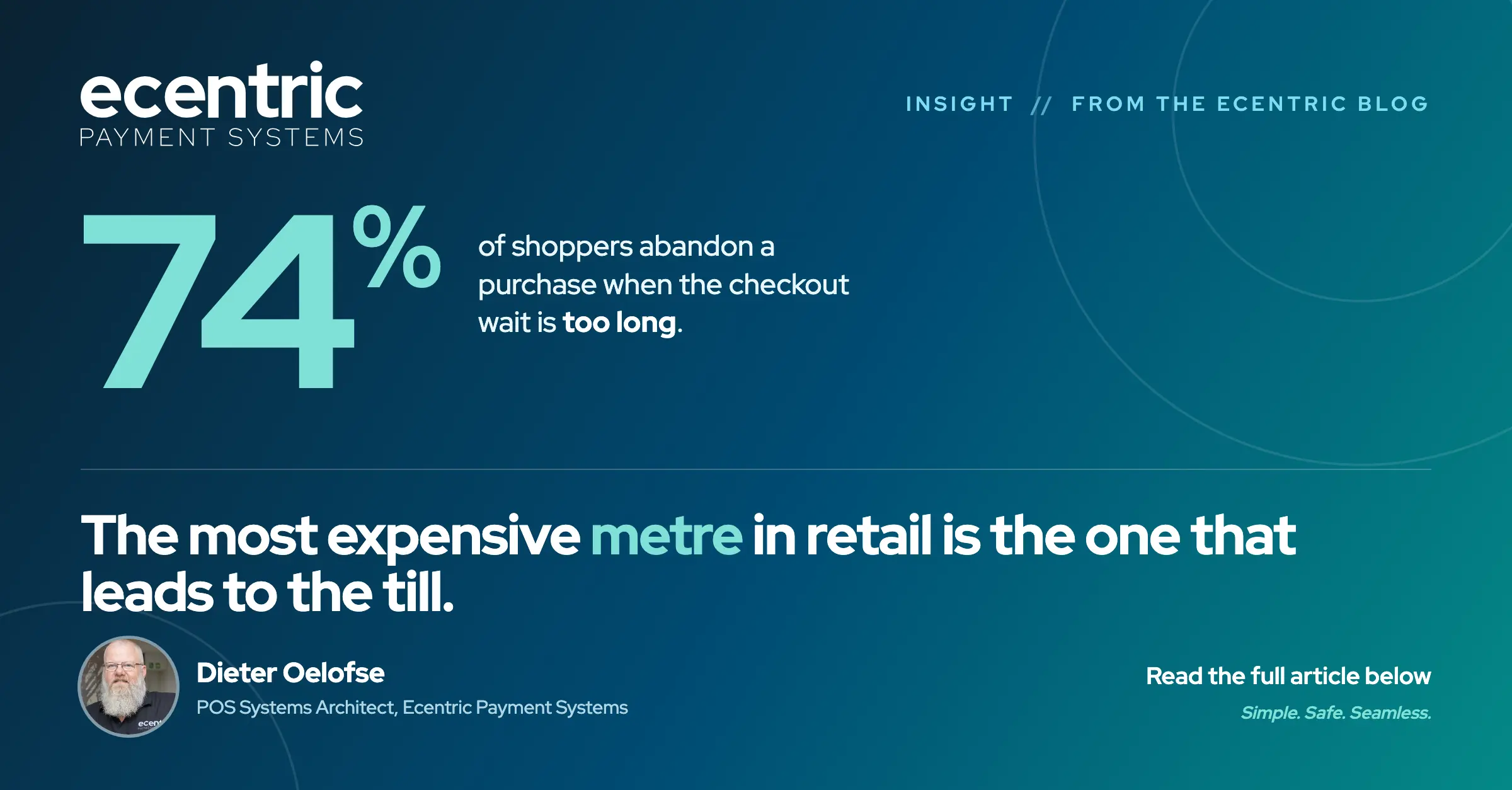
The same logic plays out at a shoe retailer, a garden centre, a specialist outdoor store. In every one of these, the buying decision has already been made before the customer reaches the till. The queue just adds time, uncertainty about stock and sizing, and one more chance for the customer to leave. Every friction point at checkout is potential lost revenue. It’s a well-studied problem globally too; one estimate puts total time spent waiting in line in the United States alone at around 37 billion hours a year, and with numbers like that, it’s not surprising that 74% of people abandon a purchase because of it.
The till isn’t obsolete; it just needs backup
None of this makes the fixed till point obsolete. Trained cashiers moving high basket volumes through a well-engineered queue still play a critical role. But the retail format that defaulted to a single till because there was no alternative now has real options, and those options can materially change the customer experience.
Think about high-volume periods like Black Friday or the festive season, when queues can stretch around the store and wait times hit an hour. Now picture a mobile payment hardware solution that takes payments in real time, right along the length of that queue, while staying properly connected to the retailer’s existing till software, stock management, and back-end reconciliation. Mobile payment hardware used to operate in isolation from the rest of the retail stack, which quietly eroded stock visibility over time. That’s changed. Today’s mobile POS devices function as a genuine extension of the till integrated with back-end systems, giving both sales consultants and customers immediate visibility into stock and sales.
Back to that hardware retailer: imagine if buying cement and bricks was as simple as finding a consultant and closing the sale on the spot, stock check and payment both handled right there, because the consultant’s mobile POS puts the entire store in their hands.
Sticky experiences beat low prices
This kind of integration and immediacy can genuinely ease some of the pressure South African retail is under right now. As customers fragment their spending and chase the best price wherever they can find it, the retailers that hold onto them won’t necessarily be the cheapest; they’ll be the ones offering sticky experiences and delightful service that give customers no reason to leave.
By Dieter Oelofse, POS Systems Architect at Ecentric Payment Systems